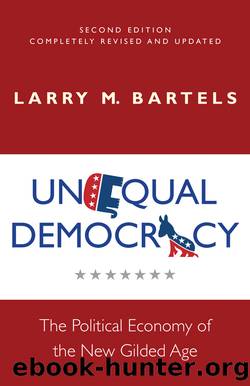
Unequal Democracy: The Political Economy of the New Gilded Age - Second Edition by Larry M. Bartels
Author:Larry M. Bartels [Bartels, Larry M.]
Language: eng
Format: epub
Tags: Political Science, American Government, General, Public Policy, Economic Policy, Political Economy, Political Ideologies, Democracy, History & Theory
ISBN: 9780691181073
Google: qXOYDwAAQBAJ
Publisher: PrincetonUP
Published: 2018-05-29T19:35:30+00:00
CHAPTER 7
The Eroding Minimum Wage
IN MAY 2007, overwhelming majorities in both chambers of Congress passed the Fair Minimum Wage Act of 2007, which increased the federal minimum wage from $5.15 per hour to $7.25 per hour in three annual 70-cent increments. The liberal Economic Policy Institute estimated that 5.3 million workers would be directly affected by the increase, with another 7.2 million indirectly benefiting from âspillover effects.â House Speaker Nancy Pelosi hailed the outcome as a victory for âthe hardest-working Americans.â It was also a victory for Pelosi and the Democratic Party, since they had made a minimum wage increase one of the primary planks in their 2006 midterm campaign platform.1
Low-wage workers were, no doubt, very grateful for the raise. However, from a broader historical perspective, the 2007 increase looks less like a major advance in the economic status of the working poor than an isolated break in a long downward trend. Even after the full increase took effect in 2009, the real value of the minimum wage was 26% less than it had been 40 years earlier. (Average real hourly wages for all American workers increased by more than one-third over that period.)2 Moreover, the real value of the minimum wage began to erode again the moment the new $7.25 wage rate took effect and will continue to do so absent further legislative action.
In this chapter I attempt to account both for the substantial increase in the real value of the minimum wage in the first two decades of the postwar era and for its subsequent decline. From the standpoint of democratic responsiveness, the decline is much more puzzling than the increase, since the public has been broadly and consistently supportive of minimum wage increases throughout this period. How has the real value of the minimum wage fallen by one-third since the late 1960s despite this strong public support? As in the case of estate tax repeal, the politics of the minimum wage seem to be driven much more by partisanship and ideology than by public opinion or, for that matter, economics.
The dramatic rise and fall of the minimum wage over the past 80 years is one of the most remarkable aspects of the political economy of inequality. The original federal minimum wage was one of the major policy innovations of the New Deal era. In 1938, Congress enacted a minimum wage of 25 cents per hour (about $4.23 in 2015 dollars) for âemployees engaged in interstate commerce or in the production of goods for interstate commerceââabout 20% of the U.S. labor force. Subsequent legislation gradually expanded coverage to include most workers in large retail and service enterprises, construction, hospitals and nursing homes, hotels and restaurants, farms, and state and local governments, eventually encompassing about 90% of all non-supervisory workers.3
While the scope of minimum wage coverage gradually increased, so did the minimum wage rate. By 1950 the minimum was 75 cents per hour, by 1968 it was $1.60 per hour, in 1981 it was $3.35 per hour, and for a decade before the most recent increase it was $5.
Download
This site does not store any files on its server. We only index and link to content provided by other sites. Please contact the content providers to delete copyright contents if any and email us, we'll remove relevant links or contents immediately.
| Anthropology | Archaeology |
| Philosophy | Politics & Government |
| Social Sciences | Sociology |
| Women's Studies |
The Secret History by Donna Tartt(19317)
The Social Justice Warrior Handbook by Lisa De Pasquale(12228)
Thirteen Reasons Why by Jay Asher(9011)
This Is How You Lose Her by Junot Diaz(6965)
Weapons of Math Destruction by Cathy O'Neil(6373)
Zero to One by Peter Thiel(5876)
Beartown by Fredrik Backman(5859)
The Myth of the Strong Leader by Archie Brown(5553)
The Fire Next Time by James Baldwin(5509)
How Democracies Die by Steven Levitsky & Daniel Ziblatt(5280)
Promise Me, Dad by Joe Biden(5193)
Stone's Rules by Roger Stone(5134)
A Higher Loyalty: Truth, Lies, and Leadership by James Comey(5021)
100 Deadly Skills by Clint Emerson(4975)
Rise and Kill First by Ronen Bergman(4842)
Secrecy World by Jake Bernstein(4807)
The David Icke Guide to the Global Conspiracy (and how to end it) by David Icke(4777)
The Doomsday Machine by Daniel Ellsberg(4559)
The Farm by Tom Rob Smith(4557)
